
Derek Besant
Body of water
Canada
10th October - 26th October 2008
www.derekbesant.com
----------------------------------------------------------------------------
BODY OF WATER / statement by Derek Michael Besant
I have always been fascinated by the fact that our bodies are made up of 98% water… therefore we have intuitive but unexplained responses and relationships to water as an element.
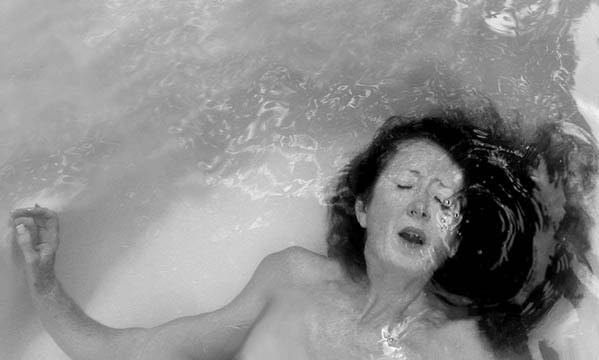
Our tears contain the same salt content asoceans and seas. Dehydration or water retention effects our physical survival. We are at the same time magnetically drawn to the water but also fear it, to some degree. I decided to investigate the theme by immersing several subjects into water circumstances. Some floated, some submerged, others appeared to dissolve or become sharply in focus depending on the light. Each figure took on some conditions dictated by the water conditions, and relected that emotionally as calm, distress, scattered or concentrated.
I photographed my subjects in a wide range of water experiences, from showers, bath tubs and pools to lakes, oceans and rivers. Some of the situations were calm and relatively straight forward in gathering the resource photos ; while other situations were difficult, dangerous and uncomfortable scenarios to put one’s self into. But I was able to gathewr enough photo resources over several years to build an archive to work from. I put the photos away for years before I looked at them to work with. The distance of time.
The images are reconstructed from several photographs of each subject. I complicated the read of each final image by introducing numerical flotsam that floats as visual debris with each person’s image. These numbers were taken from another gathered archive of my studio practice, from the cancellation marks, stamped dates and postal codes taken from the packaging of received mail. These notations of interference are like touchstones from my own personal time and experience, integrated into the dissolving portraits of my subjects.
Although I am traditionally trained as an artist, I work with advanced technologies more and more to achieve the final works I produce as museum exhibitions. These particular works are adaptations of thermal ink technologies into fabric scrims that hang from magnetic mounts like floating veils. They move slightly with air movements, allowing another reference to how water surface continually changes and collects itself again as a surface.
The soundtrack that accompanies the exhibition installation is a collaboration with music composer Paul Connolly. I gathered the sound sources from a Canadian mountain lake and the waters beneath several bridges in Venice, Italy. The voice is Isobella Couperthwaite Kreizel reading definitions of the word « water » from the Oxford Dictionary. Mixed together and recomposed they create an eerie accompaniment to the images that reaffirms the danger that always lurks silently in water.
Works from the exhibition were showcased in the Metropolitan Museum of Photography in Tokyo, Japan 2005 ; and Siggraph Conference on Computer Imaging + Interactive Technologies in Los Angeles, USA in 2004.
Body Of Water opened at The Contemporary Visual Art Centre Vestjylland in Bøvlingbjerg, Denmark and The Vyhod Cultural Media-Centre in Petrozavodsk, Russia in 2006. In 2007 the exhibition opened at The Akademija Art + Research Centre Belgrade, Serbia / The Marko Gregoric Cultural Center in Petrovac and Podgorica Cultural Center, Montenegro / The City Art Museum Skopje, Macedonia / Zavinjni Musej in Hercig-Novi. It will tour in 2008 at The Ålgården Gallery in Borås, Sweden.
I have always been fascinated by the fact that our bodies are made up of 98% water… therefore we have intuitive but unexplained responses and relationships to water as an element.
Our tears contain the same salt content asoceans and seas. Dehydration or water retention effects our physical survival. We are at the same time magnetically drawn to the water but also fear it, to some degree. I decided to investigate the theme by immersing several subjects into water circumstances. Some floated, some submerged, others appeared to dissolve or become sharply in focus depending on the light. Each figure took on some conditions dictated by the water conditions, and relected that emotionally as calm, distress, scattered or concentrated.
I photographed my subjects in a wide range of water experiences, from showers, bath tubs and pools to lakes, oceans and rivers. Some of the situations were calm and relatively straight forward in gathering the resource photos ; while other situations were difficult, dangerous and uncomfortable scenarios to put one’s self into. But I was able to gathewr enough photo resources over several years to build an archive to work from. I put the photos away for years before I looked at them to work with. The distance of time.
The images are reconstructed from several photographs of each subject. I complicated the read of each final image by introducing numerical flotsam that floats as visual debris with each person’s image. These numbers were taken from another gathered archive of my studio practice, from the cancellation marks, stamped dates and postal codes taken from the packaging of received mail. These notations of interference are like touchstones from my own personal time and experience, integrated into the dissolving portraits of my subjects.
Although I am traditionally trained as an artist, I work with advanced technologies more and more to achieve the final works I produce as museum exhibitions. These particular works are adaptations of thermal ink technologies into fabric scrims that hang from magnetic mounts like floating veils. They move slightly with air movements, allowing another reference to how water surface continually changes and collects itself again as a surface.
The soundtrack that accompanies the exhibition installation is a collaboration with music composer Paul Connolly. I gathered the sound sources from a Canadian mountain lake and the waters beneath several bridges in Venice, Italy. The voice is Isobella Couperthwaite Kreizel reading definitions of the word « water » from the Oxford Dictionary. Mixed together and recomposed they create an eerie accompaniment to the images that reaffirms the danger that always lurks silently in water.
Works from the exhibition were showcased in the Metropolitan Museum of Photography in Tokyo, Japan 2005 ; and Siggraph Conference on Computer Imaging + Interactive Technologies in Los Angeles, USA in 2004.
Body Of Water opened at The Contemporary Visual Art Centre Vestjylland in Bøvlingbjerg, Denmark and The Vyhod Cultural Media-Centre in Petrozavodsk, Russia in 2006. In 2007 the exhibition opened at The Akademija Art + Research Centre Belgrade, Serbia / The Marko Gregoric Cultural Center in Petrovac and Podgorica Cultural Center, Montenegro / The City Art Museum Skopje, Macedonia / Zavinjni Musej in Hercig-Novi. It will tour in 2008 at The Ålgården Gallery in Borås, Sweden.
www.derekbesant.com
----------------------------------------------------------------------------
CROSSING LETHE : by Marikje de Wit
Lethe. No living river is called Lethe by the Greeks ; Lethe is water of oblivion, a river in Hades, the water of which produced, in those who drank it, forgetfulness of the past.
Lethe. Forgetting. Outside time, an escape from history, consecrated to the exaltation of the instant, it has become an association with the momentary pleasure of forgetting.
No memory. No past. The root of oblivion… oublier… (to forget).
Canadian artist Derek Michael Besant describes his work with this theme, as a film dissected and reassembled from a lost manuscript. The missing parts are critical to how the images connect to one another for the viewer. But Besant’s projects are never made into films – rather, they reference how film and still images function similar to language. Communication of scenes or moments liken to connective tissue between events. It is the close-ups which determine the character of a film : « the flamboyance or phosphorescent atmosphere and the luminous mists remain throughout merely a kind of accompanyment to these closeups heightening their significance ». 1.
Filmic discourse promotes a view of sexuality and the voyeuristic by the nature of the viewer’s relative position to the scene. The dialect of sexuality, and its curious dependency on subject and object – is restricted under the veiled presence of how the water surface conceals or reveals the figure as a matter of disclosure. It is perhaps a narrative of opposites between the voyeur and the exhibitionist – subject and viewer, which allows the tension of the water surface to redirect the psychological tension that resides as a narrative in Besant’s water imagery under the description : surface noise.
The transitional devices that water invites as an element, oscillate between form and non-form. The liquid of which seas, lakes and rivers are composed, which falls as rain, washes away cities ; and when pure, is transparent, colorless, tasteless, odorless, and in one sense, empty – is also what is contained within the human body as nine-tenths of its mass. There is little context in Body of Water to locate or place the viewer’s presence in the mis-en-scène. The blindness of each figure with eyes closed, is another device purposefully utilized by the artist in his direction of the scenes. A detachment factor that at once internalizes and resists a connection outwardly to the viewer , it allows the voyeuristic gaze to continue as a time delay ; but also constructs a binary opposition within the critical discourse of the Body of Water images that translates as desire. Similar to the suspended time it takes for someone to hold their breath underwater, time is momentarily frozen in Besant’s cinemagraphic process. There are also moments which despatialize the territory between time and still image.
Besant draws upon situations that are re-enacted depictions of what water has represented historically, as a way to recontext the collective past into contemporary redefinitions. The intimacy of bathing itself has had a variety of subjective readings : from Millais’s Pre-Raphaelite Ophelia floating in her spreading dress towards consumption, the tangled bodies writhing fatefully on Gericault’s ill-fated Raft of the Medusa, Hockney’s backyard L.A. swimming pools with stilled splashes, (which owe a debt to the British Physics Professor, Arthur Worthington’s investigative studies of splashes which document the differing viscosities of fluids, most notably that of water) 2. ; to British filmmaker Peter Greenaway’s methods of drowning men at the hands of women, as retribution in Drowning by Numbers – the counterpoint to the Symbolist’s favorite theme of drowned or drowning women.
In the opening film sequence of What Lies Beneath, 3. the figure is suppressed visually below motionless water in a bathtub viewed directly from above. Suddenly, she jolts forward, breaking the water surface, gasping for air. This moment, or rather the transversing of that inaccessible distance between viewer and the figure, is the boundary of exploration Besant examines in his exhibition. Similarly provocative is the opening scene from the film Set Me Free, 4. which this time, deposits the viewer in a lake or river, with a female body suspended, floating underwater in a lifeless coma. In one movement, the figure releases telltale air bubbles from her mouth and kicks herself to the surface, as we are transported from an internalized privacy (and our own doubts of whether or not she was alive), abruptly into the present tense of real time in motion. Besant’s version of the scene re-enacted in Perpetual Night, drops the underwater viewer below the figure, so she appears to float in the mid-ground between surface and sea floor, somewhere that is at once all consuming and depthless – a kind of nowhere.
Body of Water, as a hybrid art project, moves between image and sound, creating excursions into the private self and exiles of observing and observed. Besant has explored this territory repeatedly before, on previous related themes of sleep, amnesia, dreaming, disappearing, floating, migration or falling ; all of which investigate a moment suspended somehow between uncharted destinations. In this project, the fact that the senses are effectively diminished in the figure’s realm of submersion, invokes a cinemagraphic mechanism which references a sequential narrative. Each portrayal could be an edited section out of a larger linear assemblage, like frames cut from a film.
The images are actually reconstructions made up of several photographic sources from the shooting sessions. All of them are produced in black and white, as another cinematic instrument of consistent aesthetic. The water environment is non-specific ( always located elsewhere / nowhere), so that any re-read of the image must be a response to the furtive signs from the averted or interrupted embodiment of the subject. The gaze (or non-gaze) from the subject annihilates any real connection between the viewer and subject, thereby isolating the subject further within the surrounding field of perception defined by water conditions. This gap in the equation might represent forgetfulness or loss somehow, and without the idealized point of the gaze being returned from which we decipher meaning ; we are forced to search elsewhere for the demands that the eye of the viewer automatically employs. This is what is referred to as « the dilirium of clinical perfection » : the infallibility of the apparatus is a function of the limitation of subjectivity to a single locale – the gaze of the spectator / camera. Because there is usually no otherness, no difference, no subjectivity associated with the discourse, its readability is always ensured in advance. 5.
Besant has taken pains to erase midground properties of the gaze by treating the water surface as a physical, optical and psychological barrier that may haze, shatter or dissolve all or any connection of appearances through water. Although water only occupies a cropped area that the figure is inscripted within ; it could be mimetic of an endless sea that goes on not only out of the picture plane, but into infinity, and perhaps, oblivion. It is used effectively as an isolation chamber. As Lacan effects a separation between gaze and subject – the gaze outside – always signals the excess of desire over geometrical vision (vision as the representation of space through perspective). Besant’s imagery averts attention from the viewer’s act of gazing towards the suppressed containment of the return gaze of the subject. Far from being in a state of unconsciousness, Besant’s images hold their secrets inside. There is a self-containment that excludes the precarious nature of subjectivity. The unknowing is the apparatus, and its corresponding description of the gaze that we may cast our eyes upon for the moment, but not be privy to the truth behind.
Chris Marker’s making of the film La Jetée 6. entirely in black and white stills, explores similar narrative structures, where movement is completed by the viewer’s vulnerability to be startled in the one sequence of movement when the figure opens her eyes. The contact point breaks the spell as the viewer’s role is reversed completely into being the subject, looked back upon for a single moment. Besant’s figures avoid this returned gaze ; in fact he places additional interference between the viewer and subject as optical debris and surface noise to negotiate one’s way through or around. The distances of intimacy displace the zone with a kind of interruption one might experience while talking simultaneously on the phone and directly with someone else at the same time. The dislocation effectively alters the ability for one’s concentration to connect fully with information, and instead one must capture pieces of the information to assemble.
In the classical myth, Psyche’s task in the underworld was to retrieve the dark water from the middle of the River Styx. Marker speaks of « the very role of myth, which is that of refraction, of de-multipication ». 7 . Water has the property to bend vision – or relocate one’s equilibrium, as in the opening scenes from another Chris Marker film, San Soliel, where a ferry carries sleeping bodies across the water from Okaido to the far shore. There is always the implication of potential danger wherever water is concerned.
« But how could anyone walk on the sea bed, which must bristle with dangers, and how could he climb upon the barrier, which was composed of sharp stones and corals still sharper ? And, further, how would the bell descend without capsizing in the water, or without being thrust up, for the same reason that a diver returns to the surface ? » 8.
– Umberto Eco / Technica Curiousa
When Derek Besant and Paul Connolly discuss the soundtrack bytes from the spoken text for the soundtrack, a repeated motif of « out of danger, into water » is the stitched refrain throughout the soundwave patterns. This repetition reminds us that the dark water from the deepest section of the river comes with warnings. The narration throughout the Body of Water soundtrack, which accompanies the exhibition installation, functions not unlike the rhythm set up by water in natural settings. Ebb and flow. Rip tide, red tide. The repetition of the sound starts to erode itself and dissimulates its definitions as an enigmatic presence of motion back and forth.
Besant’s dissected film, made up of black and white stills, are fleeting moments against a background of immobility. The water is frozen in the moment, embedding the figure as if in ice – most apparently portrayed in The Medusa Gaze, which alludes to the chance of matter’s ability to stop time at one particular moment. If we look further into Body of Water to what each sequential image might relinquish, we will perhaps follow a parallel structure that the soundtrack evokes. The images that seem to generate a private pleasure, or internalized secret moment – such as Bloodstream, Cerebral Hemispheres, Daughter of Thethys, or The Second of two Numbers (where the figure breathes out of the water into the air, breaking the surface) – all have a calm undertow about them, a spiritual self-center ; where awakening is anticipated even though the gaze is sealed. The condition of the waterous envelope in each of these cases is also clear and undisturbed, as simultaneous reflective psychological conditions. Other works such as Listening for Language on Mars, Perpetual Night and The Somnambulist are suspended in underwater states of calm ; the gravity displacement slows their movement down into what one truly experiences underwater as a kind of suspended state. There is no surface apparent, as these figures are submerged into their own psyches in the moment, creating a fictitious silence and separation from the outer world. The sublime gaze reflects an amplified enigmatic form of narration about these particular images.
The gaze is not outward – but enclosed. Not unlike what water enveloping each scene discloses as mute. We as viewers are invited to study each of the scenes without the conventions of the distraction of a two-way contact. This scenario is similar to the relationship one might have in an anatomy study class, with the body in a medical laboratory. Time operates differently under these circumstances, where observation can be carried out in distended lengths of looking and seeing. Besant has taught anatomy figure drawing the past thirty years at the Alberta College of Art + Design in Canada. He is familiar with the investigation of the human body as a vehicle to study in an autopsy setting. The analytical scientific position of placing the body parallel to the picture plane in Besant’s lifesized images allows for a directed implication between viewer and subject, whereby there is an uncommon intimacy that references the viewer and subject in a dialogue that is akin to crossing the River Styx.
There is an implicit suggestion in the ecstatic conviction of the arcane references to art history in certain works : Nuphar Lutea (Water Lily) looks to Munch’s blackened woodcut of the Madonna in its posture and composition pushed off to one edge of the scene, Constituent Elements pays tribute to the self-portraits of Francis Bacon with his analytical studies of destruction in corporeal flesh, Seismic Disturbance echoes further investigative acknowledgments into the realm of Bacon’s distortions through trial by water. Here, the face is not so much composed of its parts, but becomes an overall expression that mimics facial musculature in its gesture and confrontation, along with undisclosed matter floating above it like coded thought patterns.
Bloodstream’s figure floating amongst the jettisoned residue of numbers and waterlogged letters, re-awakened from Millais’s Ophelia amidst the reeds and decay of nature, is apparent in her state of suspended eroticism that is associated with other such allegorical scenes from art history. One of Fernand Knopff’s finest drawings from 1893 has as its title a line from one of Rodenbach’s poems : « the pale water which goes away along paths of silence ». 9. It is a picture of a Medieval street being gently invaded by the sea. At the end of the path of silence we shall find Ophelia… A sort of semi-monastic diablerie in a landscape inhabited by flowing undulating vomitory spectres, like a tidal wave of leeches. Also belonging to the realm of water from circa 1900, Federico Farnfinni’s painting the Virgin of the Nile, executed somewhat prior to Symbolism, converges the natural element of water with metaphor for pleasure ; the image had a great effect in Italy on account of its macabre eroticism.
Equal distance from all points portrays a penetrating reference to Holbein’s The Dead Christ from 1521 in the collection of the Kunstmuseum in Basel. The figure’s stretch and measure of limitation and limbs was inspired from Holbein’s unexpected encounter with seeing a man drowned in the Rhine. The gesture is similarly coupled by Arnold Böcklin’s Descent from the Cross, which pictures Mary Magdelene, her nudity cloaked in filmy water-like crepe , dissolving the connection between ecstacy and death; giving way to contemporary investigations from scientific logic as clinical disclosure, in looking at subject matter for face value.
Marlene Dumas extends this same territory in her 2003 painting titled : Measuring your own grave from her Venice exhibition Suspect, where a male figure is painted appearing to hold the negative space between his two outstretched arms. In the decapitated head pictured in Diving Opposites, one can reference Sartorios’s (1860 – 1932), Diana of Ephesus depiction of drama on erotisicm and death – where the central female figure lays spent or drowned next to a cloak which diverts like a stream towards the bottom corner of the image. The definition of which is struck by a bridge between sexual and spiritual ecstacy. Rossetti’s Beata Beatrix, glowing portrait of Elizabeth Siddal from 1851, with parted lips, closed eyes and tilted neck offers up the sacrificial-self knowingly. It is water that distinguishes John Deville’s (1867-1951) hermaphrodite ideal Orphé, with closed eyes floating up from the underworld on a mirrored surface capturing light, and a kingdom of death in its depths as a portrait. Besant’s rendition dissimulates the enigmatic line between orgasm and accident, where the figure precipitates cause of the narrative, being both in the moment and out of the moment ; the debris of interference that drifts as damage within the scene, physically dismantles the absence of the body from the locus of time suspended. The figure, as if enclosed in the turmoil of dreaming, appears to be a part of real time movement, perhaps about to awaken. The anticipation of this moment is what haunts the viewer’s gaze. For it transforms the stillness of the scene into desire for reinscription of what might have come just before ; and what might be imminent. We have been conditioned to generate narrative content as the equation that resides on either end of such a poised image. Besant has instilled the rebus as a visual moment to be deciphered one piece at a time. Although the image could be seen as an ending of sorts ; perhaps it is in fact the opening sequence generated out of order, encouraging the viewer to reconsider what came before, or what the impact will be as a consequence.
The artist poses the question of whether or not the figure and water might be identified as one oratio indirecta (parts of a whole). One swimming into the other… Definitions of each physical entity are no longer separately encoded. This opens up a departure point from narrative into another situation associated with non-linguistic factors : the silence where no one speaks.
« I suppose everything else about it was that clear, as things only sometimes are. It was just a matter of how much I could piece together. The problem was being on so many rivers. I had gone into the Amazon looking for pyramids but lost myself in a tangle of rivers, and the looking became a search not only for the rivers in the jungle, but also for the rivers inside, rivers with currents, rivers of time and memory that overlapped and, at times mixed with someone else’s river. » 10.
Distorted portraits of psychological and surface disturbance shown in The Delirium Vessel, Disintegration Principle, Characterized by Absence, or Stürm und Drang (storm and urge) are double exposures of the figure being consumed by concentric water patterns that threaten memory. Obliteration by abstraction. These works employ an act of destruction in order to exist. Besant confounds this further by warping the waterous ground into a more claustrophobic surrounding, that forces the body into decompression as a state of mind.
« Water covers four fifths of the earth. Water represents drinking, washing, lubricating, urinating, cleaning, cleansing, thirst requited and drowning confirmed. There is no doubt whatsoever that this water could well be the possible medium of disaster. » 11.
In Greenaway’s film Prospero’s Books, the first volume of magic was the book of water. This is a book which has lost its original color intensity from prolonged contact with water. Desaturated, drained, drowned : it is full of investigative drawings and exploratory texts written on many different thicknesses of paper, like waves in an ocean when the book is splayed open. There are drawings of every conceivable water association : seas, tempests, rain, snow, clouds, lakes, waterfalls, canals, shipwrecks, floods and tears.
As in the films of Peter Greenaway, water continues to seep into the edges of Besant’s scenarios ; sometimes as sublime metaphor, but also with disasterous consequences for the subjects. Themes of erosion, waterfalls, figures in water, drowning, or dreaming about water explore how the subject of matter affects the human body. Set in the constant presence of water, that reads of oblivion rather than merely destruction ; the same water that carries Ophelia to her destiny, does so too for most of Besant’s unwilling accomplices, lacking life perservers or life boats. Rivers of sleep, and streams of unconsciousness, an isolated peripeteia - the moment of pause where fate hangs in the balance – this is the finality of cause and effect and the mantle of erotic and decadent closure. Besant has an abundance of provocative images where the water has suppressed the figure to a degree where there might be no way back. Seven leagues under the sea. Several images have the look of deep water in fading light and extreme pressures that threaten as a dark undercurrent, similar to the soundtrack for the project.
Derek Besant has several realities to extract these feelings from in his imagery. From his past, he recounts the true story of a friend who drove her car to the parking lot at Niagara Falls one night. All she left was a hand-written note on the windshield, and her shoes neatly beside one another on the saturated observation deck above the torrent. Presumably, she jumped over the rail, never to be found again ; the notion of the water swallowing her up has haunted him for years. He would like to believe that it was all just an ingenious ploy set in motion for her to simply disappear into a secret life in a foreign country. A film script. Regardless, the awakening of the memory was rekindled again in 1995, when Besant researched the Baroque art collections in the 16th Century former convent of San Agustin - now the Museo de Arte de Querétaro in Central Mexico. The upper level galleries contain a richly eclectic collection of images founded on baptism and religious ecstasy. Paintings and drawings of waterlogged men floating above winding streams, and drenched women in states of heightened fervor rising into exalted light seemed like scenes from a manuscript of photogenic portent and metaphoric sub-text to Besant. This experience would play an integral part in his studio practice incorporating water as a setting over the next decade.
« I had not thought of myself as geography, as invisible, internal lines I could chart, but the more I searched, the more things connected, until the rivers and memories became a story, and also, perhaps, a map. » 12.
Besant’s first posed photographic recordings where water delineates the topography of the body were staged at the volcanic hotpools outside of San Miguel de Allende in Mexico in 1995. Friends were directed to consider themselves not as figures but instead, as elements of aquatic geography ; shoals, shallows, rapids, tides, streams, depths and rivulets. Their bodies in various stages of submersion in and out of water would create specific topographies from individuals’ contours. The resulting resource photographs, like other such archival information in Besant’s files, were put away for years, in order to allow some distance before being accumulated as studio material to work with.
« …having entrusted his beloved’s body to the arcs of grottos and gulfs, her hair to the flow of the currents through mazy archipelagoes, the summer moisture of her face to the glint of the waters, the mystery of her eyes to the blue of a vast desert – and the map repeated many times the features of that beloved body, in various attitudes of bays and promontories » – The Map of Tenderness / Umberto Eco / Chapter 13 pp.129-130 13.
Obsessive methodologies were employed over the decade where these works would be reconstructed, disassembled and constructed again in attempts to distill multiple portraits from each figure. Locations where Besant would gather his resources would be carefully mapped out – starting with the volcanic pools in Central Mexico – then setting up shoots off the Yucitan Peninsula in the Caribbean Sea with his figures. He orchestrated photo shoots in Québec’s St. Lawrence River and then again in Calgary’s Bow River and Toronto’s Lake Ontario in Canada. On the West Coast he posed figures in the waters off the Strait of Juan de Fuca by Victoria and in Pacific Rim National Park in British Columbia. After reviewing the 1950’s film The Swimmer, where Burt Lancaster heads home by swimming in each of his friend’s pools in sequence ; Besant focused on a number of similar scenarios including photographing people in their bathtubs or pools in Canada, Mexico, and the USA.
In 2003, with an artist’s residency at Palazzo Venier Casa Artom Study & Research Center in Venice, Italy, Besant was able to follow an organized schedule of gathering sounds of water from sites in the sinking city. Each day, he would blindly push two pins into a street map and follow a randomized route between those destinations ; recording water sound bytes from every bridge or canal along the way, day or night, until he had documented an accumulated twenty-four hour period. He set up a similar recording session along the edge of Kootenay Lake in British Columbia in 2000. These two sound sources became the basis for the Body of Water soundtrack collaboration with music composer Paul Connolly.
It is also important to Besant in targeting cities for the exhibition to be installed in, that water plays a vital role there to urban patterns and daily living. In 2004 he previewed Body of Water at the Siggraph International Conference on Imaging and Interactive Technologies in Los Angeles, California. The next year he showed part of the project in the Metropolitan Museum of Photography, in Tokyo, Japan. These two cities defined a polarity that conversed from both sides of the Pacific Ocean. In Europe, all the museum sites are linked to water in some important way. Bøvlingbjerb, Denmark, holds proximity to the North Sea off Jutland. Petrozavodsk, the capital city of Karelia in Russia, sits on the western shore of Lake Onega. Belgrade is another capital city and lies geographically at the confluence of the Danube and Sava Rivers in North Central Serbia, in the Balkans. Skopje, the capital city of Macedonia, is located on the upper course of the Vardar River. Hercig-Novi resides on the Adriatic Sea. Water in each of these sites has a connection to different but universal identity in some critical way.
INTERFERENCE, DISTURBANCE AND DISTRACTION :
There is a medical condition associated with near-sightedness called peripheral vitreous separation. It is brought about in the eye from a retinal tear followed by a plume of jet-black blood which gradually breaks up into many fine particles that appear in the field of vision like a swarm of dark insects. Gradually the brain will actively suppress the visual interference and filter it out of the vision path. 14.
Besant became fascinated by this intervention of the brain upon a physical optical disruption, and purposefully imposed visual obstacles as interruptions between himself and his subjects. He wore incorrect lenses in his glasses to observe the distortions and effects. He listed the numerical coefficients of sound wavelengths from the wave patterns in his sound gatherings, and programmed those numbers into the image settings on his computer to allow distortions that were identical to properties of the water data. He then photographed a multitude of kept envelopes, gathered from international correspondence from his files over the years, taking codes, dispatch notes, cancellation marks, shipping stickers, and inspection stamps and date cancellations as pieces of identification linked to his own time and place. He then disassembled the graphic material into screens of warped contorted graphic flotsam and jetsam, which he complicated further by integrating them into the water images in a manner similat to what he had read about peripheral vitreous separation in medical journals.
This interference is operative on two levels. The figures would now have to be seen in the context within their water-bound grounds, as having an amount of narrative pollution to be read against ; while the viewer / voyeur would at the same time have to deal with visual debris to penetrate. The fragmentation of the scene, like the optical medical condition, pre-supposes a concept of subjectivity that is both authentic but staged. It at once directs the viewer to subvert the layer of interruption, while it provokes the investigation of the figure with more determination. The decoding of definitions between sexuality / voyeurism or language / meaning, involves the viewer to attempt closure, but risks failure as a desired ideal. The artist allows conditions of chance to be part of the construction / deconstruction process of looking.
SITE PLANS : TEMPORARY INSTALLATIONS IN TRANSIENT SPACES
Besant has long been intrigued by the integration of architectural procedure in an urban setting being regarded as an unstaged temporary art installation process for a transient audience. The side-effect of erecting a building creates a performance of sorts ; where possibilities reveal themselves that become non-existent once the construction is completed. Demolition sites hold the same exciting possibilities, but in reverse. Besant’s ability to insinuate an image into a physical city setting of a construction or transient transportation or transit site, while evoking an irrational content ; is as much commentary on his architectonic analysis of incongruity in cities, as it is a suggestion that the encounter be closer to the reality of mémoire involontaire (more forgetting than memory). Reflections in windows can elicit a similar moment or glimpse that carries a factor of isolating the decisive moment : where one sees something, which is erased by another sensory switch in a blink.
Besant’s permanent public art installations from Toronto to New York City have become landmarks in their own right. His interest has looked to physical locations where multitudes are not passive or stationary ; but moving through the spaces to create opportunities for brief encounters with his themes. Banking halls, theatre foyers, street intersections, train stations, airports, bus shelters, and particulary construction sites with scaffolding, present structural mechanisms to recontext with imagery for a twenty-four hour period. Like the sequence of image stills that Besant bases his work on as a dissected film ; these more temporary projects designed for public spaces, allow narrative fragments to exist where a large audience can encounter them along the path of everyday activity. Then they are mysteriously gone.
Besant’s plan for installing the water images in the concrete bunker beneath the former Berlin Wall area of Treptow in Germany (known as the Death Strip), is a gesture to acknowledge memory and forgetting in a place where East Berliners once swam the River Spree to get to the west side under terrifying circumstances. In this context, the distorted faces and bodies in Site Plan : der freie wille / the free will acquire an urgency and palpable sense of danger in their submergence and poetic articulation. The dampness and claustophobia-inducing atmosphere of the subterranean site compress the encounter to a collective visceral recognition of past events that haunt a specific place. In 2000, when Besant exhibited his Sleepless NIght / Une Nuit Blanche out-of-focus portraits at the Musee de Arte Moderno in Buenois Aires, countless people in the audience approached him during the opening with tears in their eyes, recounting stories of loved ones lost in the Dirty War in the 1980’s ; because the images triggered a recognition in the blurred faces presented at large scale. The exhibition had become a mirror – where an unsuspecting public had rounded out the artist’s equation by bringing their own experiences to the situation, presented as a psychological artistic problem to resolve.
For the Schiebebühne (traverser) Central Hall of the former Dortmund Tramway Depot in Germany (reminding one of a cathedral of the industrial age), Besant designed an installation of frail projected images and deadpan blurring text that references the theme of Site Plan / the Culture of Sleep. The space where separate tramcars were transported from one repair station to another on movable working platforms, had a history of shifting floor sections and long working hours. Besant’s projected text definitions of sleep create a disorienting, moving ground that submerges and reappears in slow dissolves. A projected underwater figure similarily appears to surface and submerge in slow gradations in and out of water on a suspended scrim at the end of the hall. A constructed soundtrack of a night train in the distance that gradually arrives into one end of the station, audibly louder and louder, and exits out the other end over a fifteen minute sequence, heightens the real time element ; correographing the scene into a film clip vision. Fade to black.
Site Plan / Lethe was conceived as a series of time-lapse images that might somehow move, or appear to change slowly, in public spaces that had physical movement in real time at a much more rapid pace. The Kyoto Central Train Station was selected for situating viewers on the escalators coming up from the arrivals platforms to the viewing site at a particular encounter speed. The bath as a ritualistic act in Japanese culture, is an important identity equaling device that encompasses the nakedness of body and mind. In the wake of busy travellers, this poetic image references the suspended moment outside of the daily station traffic. In a similar way, one also encounters Buddist shrines in the busy streets, as a sign to withdraw into the personal self for a moment of reflection and vulnerability.
Conversely, the dual image sequence concept for Site Plan / Paddington Tube Station, London, U.K., temptingly exposes the gaze of the viewer to the bather between two positions only seconds apart. Conceptualized from a rereading of the existing floor text warning between the platforms and train doors, which reads Mind The Gap ; the effect contains a simultaneous internalization amidst the confusion and constancy of moving travellers in ever crossing trajectories. The sequenced images leave a fascinating mixture of contradictory emotions ; between blind inward sight and the unseen witnessing of everyday moments and personal events on the pedestrian platform below.
Another London site selected during the architectural refurbishing of The Brown Hotel on Ablemarle Street, was the kind of site Besant favors, with its complicated temporary structural exo-skeleton of assembled scaffolding. The surrounding barrier of safety netting, tarps, and cribbing boards redefines aspects of the building’s exposed past, while creating a transient moment to impose an image into the danger of the site under such siege. The figure in this case appears to hold back the threat of a tidal wave, or the emotive counterbalance of the building stripped of its skin. The naked male body is depicted in an almost crucified posture against the destruction of the obscured building facade. There exists a fragility and tension between the image within the weight of the architectural system, that resembles a staged scene out of context in the street.
Site Plan / Sirena appears as an integrated concept on another architectural temporary refurbishment ; this time on the Grand Canal across from The Palazzo Venier Casa Artom Study + Research Centre in Venice, where Besant worked in 2003 to record the soundtrack data for Body of Water. The heavy boat traffic along this city’s waterways creates another constant audience that is in motion to view the intervention en passant at a particular speed from either direction. In the measure of time it takes to encounter the image, it is in the process of appearing to be moving by you ; rather than you moving by it. In a city where water is the lifestream on every level, the imagery holds significance from a historical grounding in myth and narrative that includes the presence of sirens, who draw sailors to their doom by their seductive song. Does the figure beckon you toward her, or raise the banner signal to stay away ? One must consider the void of interpretation in the gesture between waving, or drowning. Besant’s images all hold destructive aspects of beauty in their grasp, as the soundtrack warns.
« …and suddenly he was aware that he could no longer make out the rocks near the shore, a sign that the water had begun to rise ; and the sun, which earlier he had seen without having to raise his head, was now truly over him. So from the moment of the bell’s disappearance, not minutes, but hours had passed. » 15.
Umbert Eco
Toronto’s Pearson International Airport, like the train stations, creates a setting where large groups of travellers move through a public space constantly, over time. Site Plan / Torrent is a concept that incorporates the changing light through the window sections to imply movement of the water around the figure who looms against gravity ; similar to many church ceiling paintings, where floating figures have appeared for centuries. Benevolent and overseeing, the figure watches the exchange and order below from a heavenly remove which could turn into a storm with one wave of her hand. In the same city, but intruded into a gaping construction site near the corner of Dundas and Yonge Streets ; another version of a waterous male figure stretches between girders, retaining wall steel and concrete underpinnings of the construction site. The setting creates a strange framework for the figure to be off-balance against, while allowing light to penetrate the scrim and juxtapose the two levels of exposure openly in the public domain of a large city. There is an implicit nakedness between both the contained female figure and the raw framework of the architectural drawing of structure in space against the skyline.
In another city, along a construction refurbishment to another historical building facade in Calgary, the transparency of the veil scrim creates an illusion of the water ground appearing to dissolve itself in-situ ; while the male figure with closed eyes appears to be unaware of this undoing which might erase him next – rendering him invisible. Derrida explains this transaction thus : « To be the other of the visible, absolute invisibility must neither take place elsewhere nor constitute another visible, that is, something that does not yet appear or has already disappeared – something whose spectacle of monumental ruins would call for reconstitution, regathering from memory, rememberment. » 16.
If Besant’s dissected film is evident from the accumulated moments contained in the exhibition ; it acts as a fictitious narrative that generates a dualistic principle – that every meaning is an act of interpretation and negotiation of representations. Although photography has always played a role in his research, it is the conglomeration of investigative process that interests him in his work ultimately. Besant’s lieu d’oubli places his sequence of images in repositioned situations : a mystery conjured into an idea as a deliberation kept distorted or blurred, to be looked into but not necessarily solved. Moving easily between studio, museum, or public scrutiny in unexpected sites in different cities, he continues to mix strategic themes of identity and narrative condensation – with an emphasis on the the avoidance of the human gaze. His vocabulary of chance and cinemotive perpective, suggests connections between psychological implication and human frailty. Faulty memory patterns or exposure of the body metaphor ascribe multiple states of mind and meaning as subject matter to be reconsidered by a viewer.
In the dissected film, names might change ; but themes resurface like the migration of sedimentary layers of geology. Lethe loses the memory of itself finally, and the River Styx is said to wind around Hades nine times. There are five other rivers of the underworld found in literature : Acheron, Phlegethon, Aornis, Cocytus and Lethe.
But it is the same river for Besant ; only the landscape on either bank seems to change.
Lethe. No living river is called Lethe by the Greeks ; Lethe is water of oblivion, a river in Hades, the water of which produced, in those who drank it, forgetfulness of the past.
Lethe. Forgetting. Outside time, an escape from history, consecrated to the exaltation of the instant, it has become an association with the momentary pleasure of forgetting.
No memory. No past. The root of oblivion… oublier… (to forget).
Canadian artist Derek Michael Besant describes his work with this theme, as a film dissected and reassembled from a lost manuscript. The missing parts are critical to how the images connect to one another for the viewer. But Besant’s projects are never made into films – rather, they reference how film and still images function similar to language. Communication of scenes or moments liken to connective tissue between events. It is the close-ups which determine the character of a film : « the flamboyance or phosphorescent atmosphere and the luminous mists remain throughout merely a kind of accompanyment to these closeups heightening their significance ». 1.
Filmic discourse promotes a view of sexuality and the voyeuristic by the nature of the viewer’s relative position to the scene. The dialect of sexuality, and its curious dependency on subject and object – is restricted under the veiled presence of how the water surface conceals or reveals the figure as a matter of disclosure. It is perhaps a narrative of opposites between the voyeur and the exhibitionist – subject and viewer, which allows the tension of the water surface to redirect the psychological tension that resides as a narrative in Besant’s water imagery under the description : surface noise.
The transitional devices that water invites as an element, oscillate between form and non-form. The liquid of which seas, lakes and rivers are composed, which falls as rain, washes away cities ; and when pure, is transparent, colorless, tasteless, odorless, and in one sense, empty – is also what is contained within the human body as nine-tenths of its mass. There is little context in Body of Water to locate or place the viewer’s presence in the mis-en-scène. The blindness of each figure with eyes closed, is another device purposefully utilized by the artist in his direction of the scenes. A detachment factor that at once internalizes and resists a connection outwardly to the viewer , it allows the voyeuristic gaze to continue as a time delay ; but also constructs a binary opposition within the critical discourse of the Body of Water images that translates as desire. Similar to the suspended time it takes for someone to hold their breath underwater, time is momentarily frozen in Besant’s cinemagraphic process. There are also moments which despatialize the territory between time and still image.
Besant draws upon situations that are re-enacted depictions of what water has represented historically, as a way to recontext the collective past into contemporary redefinitions. The intimacy of bathing itself has had a variety of subjective readings : from Millais’s Pre-Raphaelite Ophelia floating in her spreading dress towards consumption, the tangled bodies writhing fatefully on Gericault’s ill-fated Raft of the Medusa, Hockney’s backyard L.A. swimming pools with stilled splashes, (which owe a debt to the British Physics Professor, Arthur Worthington’s investigative studies of splashes which document the differing viscosities of fluids, most notably that of water) 2. ; to British filmmaker Peter Greenaway’s methods of drowning men at the hands of women, as retribution in Drowning by Numbers – the counterpoint to the Symbolist’s favorite theme of drowned or drowning women.
In the opening film sequence of What Lies Beneath, 3. the figure is suppressed visually below motionless water in a bathtub viewed directly from above. Suddenly, she jolts forward, breaking the water surface, gasping for air. This moment, or rather the transversing of that inaccessible distance between viewer and the figure, is the boundary of exploration Besant examines in his exhibition. Similarly provocative is the opening scene from the film Set Me Free, 4. which this time, deposits the viewer in a lake or river, with a female body suspended, floating underwater in a lifeless coma. In one movement, the figure releases telltale air bubbles from her mouth and kicks herself to the surface, as we are transported from an internalized privacy (and our own doubts of whether or not she was alive), abruptly into the present tense of real time in motion. Besant’s version of the scene re-enacted in Perpetual Night, drops the underwater viewer below the figure, so she appears to float in the mid-ground between surface and sea floor, somewhere that is at once all consuming and depthless – a kind of nowhere.
Body of Water, as a hybrid art project, moves between image and sound, creating excursions into the private self and exiles of observing and observed. Besant has explored this territory repeatedly before, on previous related themes of sleep, amnesia, dreaming, disappearing, floating, migration or falling ; all of which investigate a moment suspended somehow between uncharted destinations. In this project, the fact that the senses are effectively diminished in the figure’s realm of submersion, invokes a cinemagraphic mechanism which references a sequential narrative. Each portrayal could be an edited section out of a larger linear assemblage, like frames cut from a film.
The images are actually reconstructions made up of several photographic sources from the shooting sessions. All of them are produced in black and white, as another cinematic instrument of consistent aesthetic. The water environment is non-specific ( always located elsewhere / nowhere), so that any re-read of the image must be a response to the furtive signs from the averted or interrupted embodiment of the subject. The gaze (or non-gaze) from the subject annihilates any real connection between the viewer and subject, thereby isolating the subject further within the surrounding field of perception defined by water conditions. This gap in the equation might represent forgetfulness or loss somehow, and without the idealized point of the gaze being returned from which we decipher meaning ; we are forced to search elsewhere for the demands that the eye of the viewer automatically employs. This is what is referred to as « the dilirium of clinical perfection » : the infallibility of the apparatus is a function of the limitation of subjectivity to a single locale – the gaze of the spectator / camera. Because there is usually no otherness, no difference, no subjectivity associated with the discourse, its readability is always ensured in advance. 5.
Besant has taken pains to erase midground properties of the gaze by treating the water surface as a physical, optical and psychological barrier that may haze, shatter or dissolve all or any connection of appearances through water. Although water only occupies a cropped area that the figure is inscripted within ; it could be mimetic of an endless sea that goes on not only out of the picture plane, but into infinity, and perhaps, oblivion. It is used effectively as an isolation chamber. As Lacan effects a separation between gaze and subject – the gaze outside – always signals the excess of desire over geometrical vision (vision as the representation of space through perspective). Besant’s imagery averts attention from the viewer’s act of gazing towards the suppressed containment of the return gaze of the subject. Far from being in a state of unconsciousness, Besant’s images hold their secrets inside. There is a self-containment that excludes the precarious nature of subjectivity. The unknowing is the apparatus, and its corresponding description of the gaze that we may cast our eyes upon for the moment, but not be privy to the truth behind.
Chris Marker’s making of the film La Jetée 6. entirely in black and white stills, explores similar narrative structures, where movement is completed by the viewer’s vulnerability to be startled in the one sequence of movement when the figure opens her eyes. The contact point breaks the spell as the viewer’s role is reversed completely into being the subject, looked back upon for a single moment. Besant’s figures avoid this returned gaze ; in fact he places additional interference between the viewer and subject as optical debris and surface noise to negotiate one’s way through or around. The distances of intimacy displace the zone with a kind of interruption one might experience while talking simultaneously on the phone and directly with someone else at the same time. The dislocation effectively alters the ability for one’s concentration to connect fully with information, and instead one must capture pieces of the information to assemble.
In the classical myth, Psyche’s task in the underworld was to retrieve the dark water from the middle of the River Styx. Marker speaks of « the very role of myth, which is that of refraction, of de-multipication ». 7 . Water has the property to bend vision – or relocate one’s equilibrium, as in the opening scenes from another Chris Marker film, San Soliel, where a ferry carries sleeping bodies across the water from Okaido to the far shore. There is always the implication of potential danger wherever water is concerned.
« But how could anyone walk on the sea bed, which must bristle with dangers, and how could he climb upon the barrier, which was composed of sharp stones and corals still sharper ? And, further, how would the bell descend without capsizing in the water, or without being thrust up, for the same reason that a diver returns to the surface ? » 8.
– Umberto Eco / Technica Curiousa
When Derek Besant and Paul Connolly discuss the soundtrack bytes from the spoken text for the soundtrack, a repeated motif of « out of danger, into water » is the stitched refrain throughout the soundwave patterns. This repetition reminds us that the dark water from the deepest section of the river comes with warnings. The narration throughout the Body of Water soundtrack, which accompanies the exhibition installation, functions not unlike the rhythm set up by water in natural settings. Ebb and flow. Rip tide, red tide. The repetition of the sound starts to erode itself and dissimulates its definitions as an enigmatic presence of motion back and forth.
Besant’s dissected film, made up of black and white stills, are fleeting moments against a background of immobility. The water is frozen in the moment, embedding the figure as if in ice – most apparently portrayed in The Medusa Gaze, which alludes to the chance of matter’s ability to stop time at one particular moment. If we look further into Body of Water to what each sequential image might relinquish, we will perhaps follow a parallel structure that the soundtrack evokes. The images that seem to generate a private pleasure, or internalized secret moment – such as Bloodstream, Cerebral Hemispheres, Daughter of Thethys, or The Second of two Numbers (where the figure breathes out of the water into the air, breaking the surface) – all have a calm undertow about them, a spiritual self-center ; where awakening is anticipated even though the gaze is sealed. The condition of the waterous envelope in each of these cases is also clear and undisturbed, as simultaneous reflective psychological conditions. Other works such as Listening for Language on Mars, Perpetual Night and The Somnambulist are suspended in underwater states of calm ; the gravity displacement slows their movement down into what one truly experiences underwater as a kind of suspended state. There is no surface apparent, as these figures are submerged into their own psyches in the moment, creating a fictitious silence and separation from the outer world. The sublime gaze reflects an amplified enigmatic form of narration about these particular images.
The gaze is not outward – but enclosed. Not unlike what water enveloping each scene discloses as mute. We as viewers are invited to study each of the scenes without the conventions of the distraction of a two-way contact. This scenario is similar to the relationship one might have in an anatomy study class, with the body in a medical laboratory. Time operates differently under these circumstances, where observation can be carried out in distended lengths of looking and seeing. Besant has taught anatomy figure drawing the past thirty years at the Alberta College of Art + Design in Canada. He is familiar with the investigation of the human body as a vehicle to study in an autopsy setting. The analytical scientific position of placing the body parallel to the picture plane in Besant’s lifesized images allows for a directed implication between viewer and subject, whereby there is an uncommon intimacy that references the viewer and subject in a dialogue that is akin to crossing the River Styx.
There is an implicit suggestion in the ecstatic conviction of the arcane references to art history in certain works : Nuphar Lutea (Water Lily) looks to Munch’s blackened woodcut of the Madonna in its posture and composition pushed off to one edge of the scene, Constituent Elements pays tribute to the self-portraits of Francis Bacon with his analytical studies of destruction in corporeal flesh, Seismic Disturbance echoes further investigative acknowledgments into the realm of Bacon’s distortions through trial by water. Here, the face is not so much composed of its parts, but becomes an overall expression that mimics facial musculature in its gesture and confrontation, along with undisclosed matter floating above it like coded thought patterns.
Bloodstream’s figure floating amongst the jettisoned residue of numbers and waterlogged letters, re-awakened from Millais’s Ophelia amidst the reeds and decay of nature, is apparent in her state of suspended eroticism that is associated with other such allegorical scenes from art history. One of Fernand Knopff’s finest drawings from 1893 has as its title a line from one of Rodenbach’s poems : « the pale water which goes away along paths of silence ». 9. It is a picture of a Medieval street being gently invaded by the sea. At the end of the path of silence we shall find Ophelia… A sort of semi-monastic diablerie in a landscape inhabited by flowing undulating vomitory spectres, like a tidal wave of leeches. Also belonging to the realm of water from circa 1900, Federico Farnfinni’s painting the Virgin of the Nile, executed somewhat prior to Symbolism, converges the natural element of water with metaphor for pleasure ; the image had a great effect in Italy on account of its macabre eroticism.
Equal distance from all points portrays a penetrating reference to Holbein’s The Dead Christ from 1521 in the collection of the Kunstmuseum in Basel. The figure’s stretch and measure of limitation and limbs was inspired from Holbein’s unexpected encounter with seeing a man drowned in the Rhine. The gesture is similarly coupled by Arnold Böcklin’s Descent from the Cross, which pictures Mary Magdelene, her nudity cloaked in filmy water-like crepe , dissolving the connection between ecstacy and death; giving way to contemporary investigations from scientific logic as clinical disclosure, in looking at subject matter for face value.
Marlene Dumas extends this same territory in her 2003 painting titled : Measuring your own grave from her Venice exhibition Suspect, where a male figure is painted appearing to hold the negative space between his two outstretched arms. In the decapitated head pictured in Diving Opposites, one can reference Sartorios’s (1860 – 1932), Diana of Ephesus depiction of drama on erotisicm and death – where the central female figure lays spent or drowned next to a cloak which diverts like a stream towards the bottom corner of the image. The definition of which is struck by a bridge between sexual and spiritual ecstacy. Rossetti’s Beata Beatrix, glowing portrait of Elizabeth Siddal from 1851, with parted lips, closed eyes and tilted neck offers up the sacrificial-self knowingly. It is water that distinguishes John Deville’s (1867-1951) hermaphrodite ideal Orphé, with closed eyes floating up from the underworld on a mirrored surface capturing light, and a kingdom of death in its depths as a portrait. Besant’s rendition dissimulates the enigmatic line between orgasm and accident, where the figure precipitates cause of the narrative, being both in the moment and out of the moment ; the debris of interference that drifts as damage within the scene, physically dismantles the absence of the body from the locus of time suspended. The figure, as if enclosed in the turmoil of dreaming, appears to be a part of real time movement, perhaps about to awaken. The anticipation of this moment is what haunts the viewer’s gaze. For it transforms the stillness of the scene into desire for reinscription of what might have come just before ; and what might be imminent. We have been conditioned to generate narrative content as the equation that resides on either end of such a poised image. Besant has instilled the rebus as a visual moment to be deciphered one piece at a time. Although the image could be seen as an ending of sorts ; perhaps it is in fact the opening sequence generated out of order, encouraging the viewer to reconsider what came before, or what the impact will be as a consequence.
The artist poses the question of whether or not the figure and water might be identified as one oratio indirecta (parts of a whole). One swimming into the other… Definitions of each physical entity are no longer separately encoded. This opens up a departure point from narrative into another situation associated with non-linguistic factors : the silence where no one speaks.
« I suppose everything else about it was that clear, as things only sometimes are. It was just a matter of how much I could piece together. The problem was being on so many rivers. I had gone into the Amazon looking for pyramids but lost myself in a tangle of rivers, and the looking became a search not only for the rivers in the jungle, but also for the rivers inside, rivers with currents, rivers of time and memory that overlapped and, at times mixed with someone else’s river. » 10.
Distorted portraits of psychological and surface disturbance shown in The Delirium Vessel, Disintegration Principle, Characterized by Absence, or Stürm und Drang (storm and urge) are double exposures of the figure being consumed by concentric water patterns that threaten memory. Obliteration by abstraction. These works employ an act of destruction in order to exist. Besant confounds this further by warping the waterous ground into a more claustrophobic surrounding, that forces the body into decompression as a state of mind.
« Water covers four fifths of the earth. Water represents drinking, washing, lubricating, urinating, cleaning, cleansing, thirst requited and drowning confirmed. There is no doubt whatsoever that this water could well be the possible medium of disaster. » 11.
In Greenaway’s film Prospero’s Books, the first volume of magic was the book of water. This is a book which has lost its original color intensity from prolonged contact with water. Desaturated, drained, drowned : it is full of investigative drawings and exploratory texts written on many different thicknesses of paper, like waves in an ocean when the book is splayed open. There are drawings of every conceivable water association : seas, tempests, rain, snow, clouds, lakes, waterfalls, canals, shipwrecks, floods and tears.
As in the films of Peter Greenaway, water continues to seep into the edges of Besant’s scenarios ; sometimes as sublime metaphor, but also with disasterous consequences for the subjects. Themes of erosion, waterfalls, figures in water, drowning, or dreaming about water explore how the subject of matter affects the human body. Set in the constant presence of water, that reads of oblivion rather than merely destruction ; the same water that carries Ophelia to her destiny, does so too for most of Besant’s unwilling accomplices, lacking life perservers or life boats. Rivers of sleep, and streams of unconsciousness, an isolated peripeteia - the moment of pause where fate hangs in the balance – this is the finality of cause and effect and the mantle of erotic and decadent closure. Besant has an abundance of provocative images where the water has suppressed the figure to a degree where there might be no way back. Seven leagues under the sea. Several images have the look of deep water in fading light and extreme pressures that threaten as a dark undercurrent, similar to the soundtrack for the project.
Derek Besant has several realities to extract these feelings from in his imagery. From his past, he recounts the true story of a friend who drove her car to the parking lot at Niagara Falls one night. All she left was a hand-written note on the windshield, and her shoes neatly beside one another on the saturated observation deck above the torrent. Presumably, she jumped over the rail, never to be found again ; the notion of the water swallowing her up has haunted him for years. He would like to believe that it was all just an ingenious ploy set in motion for her to simply disappear into a secret life in a foreign country. A film script. Regardless, the awakening of the memory was rekindled again in 1995, when Besant researched the Baroque art collections in the 16th Century former convent of San Agustin - now the Museo de Arte de Querétaro in Central Mexico. The upper level galleries contain a richly eclectic collection of images founded on baptism and religious ecstasy. Paintings and drawings of waterlogged men floating above winding streams, and drenched women in states of heightened fervor rising into exalted light seemed like scenes from a manuscript of photogenic portent and metaphoric sub-text to Besant. This experience would play an integral part in his studio practice incorporating water as a setting over the next decade.
« I had not thought of myself as geography, as invisible, internal lines I could chart, but the more I searched, the more things connected, until the rivers and memories became a story, and also, perhaps, a map. » 12.
Besant’s first posed photographic recordings where water delineates the topography of the body were staged at the volcanic hotpools outside of San Miguel de Allende in Mexico in 1995. Friends were directed to consider themselves not as figures but instead, as elements of aquatic geography ; shoals, shallows, rapids, tides, streams, depths and rivulets. Their bodies in various stages of submersion in and out of water would create specific topographies from individuals’ contours. The resulting resource photographs, like other such archival information in Besant’s files, were put away for years, in order to allow some distance before being accumulated as studio material to work with.
« …having entrusted his beloved’s body to the arcs of grottos and gulfs, her hair to the flow of the currents through mazy archipelagoes, the summer moisture of her face to the glint of the waters, the mystery of her eyes to the blue of a vast desert – and the map repeated many times the features of that beloved body, in various attitudes of bays and promontories » – The Map of Tenderness / Umberto Eco / Chapter 13 pp.129-130 13.
Obsessive methodologies were employed over the decade where these works would be reconstructed, disassembled and constructed again in attempts to distill multiple portraits from each figure. Locations where Besant would gather his resources would be carefully mapped out – starting with the volcanic pools in Central Mexico – then setting up shoots off the Yucitan Peninsula in the Caribbean Sea with his figures. He orchestrated photo shoots in Québec’s St. Lawrence River and then again in Calgary’s Bow River and Toronto’s Lake Ontario in Canada. On the West Coast he posed figures in the waters off the Strait of Juan de Fuca by Victoria and in Pacific Rim National Park in British Columbia. After reviewing the 1950’s film The Swimmer, where Burt Lancaster heads home by swimming in each of his friend’s pools in sequence ; Besant focused on a number of similar scenarios including photographing people in their bathtubs or pools in Canada, Mexico, and the USA.
In 2003, with an artist’s residency at Palazzo Venier Casa Artom Study & Research Center in Venice, Italy, Besant was able to follow an organized schedule of gathering sounds of water from sites in the sinking city. Each day, he would blindly push two pins into a street map and follow a randomized route between those destinations ; recording water sound bytes from every bridge or canal along the way, day or night, until he had documented an accumulated twenty-four hour period. He set up a similar recording session along the edge of Kootenay Lake in British Columbia in 2000. These two sound sources became the basis for the Body of Water soundtrack collaboration with music composer Paul Connolly.
It is also important to Besant in targeting cities for the exhibition to be installed in, that water plays a vital role there to urban patterns and daily living. In 2004 he previewed Body of Water at the Siggraph International Conference on Imaging and Interactive Technologies in Los Angeles, California. The next year he showed part of the project in the Metropolitan Museum of Photography, in Tokyo, Japan. These two cities defined a polarity that conversed from both sides of the Pacific Ocean. In Europe, all the museum sites are linked to water in some important way. Bøvlingbjerb, Denmark, holds proximity to the North Sea off Jutland. Petrozavodsk, the capital city of Karelia in Russia, sits on the western shore of Lake Onega. Belgrade is another capital city and lies geographically at the confluence of the Danube and Sava Rivers in North Central Serbia, in the Balkans. Skopje, the capital city of Macedonia, is located on the upper course of the Vardar River. Hercig-Novi resides on the Adriatic Sea. Water in each of these sites has a connection to different but universal identity in some critical way.
INTERFERENCE, DISTURBANCE AND DISTRACTION :
There is a medical condition associated with near-sightedness called peripheral vitreous separation. It is brought about in the eye from a retinal tear followed by a plume of jet-black blood which gradually breaks up into many fine particles that appear in the field of vision like a swarm of dark insects. Gradually the brain will actively suppress the visual interference and filter it out of the vision path. 14.
Besant became fascinated by this intervention of the brain upon a physical optical disruption, and purposefully imposed visual obstacles as interruptions between himself and his subjects. He wore incorrect lenses in his glasses to observe the distortions and effects. He listed the numerical coefficients of sound wavelengths from the wave patterns in his sound gatherings, and programmed those numbers into the image settings on his computer to allow distortions that were identical to properties of the water data. He then photographed a multitude of kept envelopes, gathered from international correspondence from his files over the years, taking codes, dispatch notes, cancellation marks, shipping stickers, and inspection stamps and date cancellations as pieces of identification linked to his own time and place. He then disassembled the graphic material into screens of warped contorted graphic flotsam and jetsam, which he complicated further by integrating them into the water images in a manner similat to what he had read about peripheral vitreous separation in medical journals.
This interference is operative on two levels. The figures would now have to be seen in the context within their water-bound grounds, as having an amount of narrative pollution to be read against ; while the viewer / voyeur would at the same time have to deal with visual debris to penetrate. The fragmentation of the scene, like the optical medical condition, pre-supposes a concept of subjectivity that is both authentic but staged. It at once directs the viewer to subvert the layer of interruption, while it provokes the investigation of the figure with more determination. The decoding of definitions between sexuality / voyeurism or language / meaning, involves the viewer to attempt closure, but risks failure as a desired ideal. The artist allows conditions of chance to be part of the construction / deconstruction process of looking.
SITE PLANS : TEMPORARY INSTALLATIONS IN TRANSIENT SPACES
Besant has long been intrigued by the integration of architectural procedure in an urban setting being regarded as an unstaged temporary art installation process for a transient audience. The side-effect of erecting a building creates a performance of sorts ; where possibilities reveal themselves that become non-existent once the construction is completed. Demolition sites hold the same exciting possibilities, but in reverse. Besant’s ability to insinuate an image into a physical city setting of a construction or transient transportation or transit site, while evoking an irrational content ; is as much commentary on his architectonic analysis of incongruity in cities, as it is a suggestion that the encounter be closer to the reality of mémoire involontaire (more forgetting than memory). Reflections in windows can elicit a similar moment or glimpse that carries a factor of isolating the decisive moment : where one sees something, which is erased by another sensory switch in a blink.
Besant’s permanent public art installations from Toronto to New York City have become landmarks in their own right. His interest has looked to physical locations where multitudes are not passive or stationary ; but moving through the spaces to create opportunities for brief encounters with his themes. Banking halls, theatre foyers, street intersections, train stations, airports, bus shelters, and particulary construction sites with scaffolding, present structural mechanisms to recontext with imagery for a twenty-four hour period. Like the sequence of image stills that Besant bases his work on as a dissected film ; these more temporary projects designed for public spaces, allow narrative fragments to exist where a large audience can encounter them along the path of everyday activity. Then they are mysteriously gone.
Besant’s plan for installing the water images in the concrete bunker beneath the former Berlin Wall area of Treptow in Germany (known as the Death Strip), is a gesture to acknowledge memory and forgetting in a place where East Berliners once swam the River Spree to get to the west side under terrifying circumstances. In this context, the distorted faces and bodies in Site Plan : der freie wille / the free will acquire an urgency and palpable sense of danger in their submergence and poetic articulation. The dampness and claustophobia-inducing atmosphere of the subterranean site compress the encounter to a collective visceral recognition of past events that haunt a specific place. In 2000, when Besant exhibited his Sleepless NIght / Une Nuit Blanche out-of-focus portraits at the Musee de Arte Moderno in Buenois Aires, countless people in the audience approached him during the opening with tears in their eyes, recounting stories of loved ones lost in the Dirty War in the 1980’s ; because the images triggered a recognition in the blurred faces presented at large scale. The exhibition had become a mirror – where an unsuspecting public had rounded out the artist’s equation by bringing their own experiences to the situation, presented as a psychological artistic problem to resolve.
For the Schiebebühne (traverser) Central Hall of the former Dortmund Tramway Depot in Germany (reminding one of a cathedral of the industrial age), Besant designed an installation of frail projected images and deadpan blurring text that references the theme of Site Plan / the Culture of Sleep. The space where separate tramcars were transported from one repair station to another on movable working platforms, had a history of shifting floor sections and long working hours. Besant’s projected text definitions of sleep create a disorienting, moving ground that submerges and reappears in slow dissolves. A projected underwater figure similarily appears to surface and submerge in slow gradations in and out of water on a suspended scrim at the end of the hall. A constructed soundtrack of a night train in the distance that gradually arrives into one end of the station, audibly louder and louder, and exits out the other end over a fifteen minute sequence, heightens the real time element ; correographing the scene into a film clip vision. Fade to black.
Site Plan / Lethe was conceived as a series of time-lapse images that might somehow move, or appear to change slowly, in public spaces that had physical movement in real time at a much more rapid pace. The Kyoto Central Train Station was selected for situating viewers on the escalators coming up from the arrivals platforms to the viewing site at a particular encounter speed. The bath as a ritualistic act in Japanese culture, is an important identity equaling device that encompasses the nakedness of body and mind. In the wake of busy travellers, this poetic image references the suspended moment outside of the daily station traffic. In a similar way, one also encounters Buddist shrines in the busy streets, as a sign to withdraw into the personal self for a moment of reflection and vulnerability.
Conversely, the dual image sequence concept for Site Plan / Paddington Tube Station, London, U.K., temptingly exposes the gaze of the viewer to the bather between two positions only seconds apart. Conceptualized from a rereading of the existing floor text warning between the platforms and train doors, which reads Mind The Gap ; the effect contains a simultaneous internalization amidst the confusion and constancy of moving travellers in ever crossing trajectories. The sequenced images leave a fascinating mixture of contradictory emotions ; between blind inward sight and the unseen witnessing of everyday moments and personal events on the pedestrian platform below.
Another London site selected during the architectural refurbishing of The Brown Hotel on Ablemarle Street, was the kind of site Besant favors, with its complicated temporary structural exo-skeleton of assembled scaffolding. The surrounding barrier of safety netting, tarps, and cribbing boards redefines aspects of the building’s exposed past, while creating a transient moment to impose an image into the danger of the site under such siege. The figure in this case appears to hold back the threat of a tidal wave, or the emotive counterbalance of the building stripped of its skin. The naked male body is depicted in an almost crucified posture against the destruction of the obscured building facade. There exists a fragility and tension between the image within the weight of the architectural system, that resembles a staged scene out of context in the street.
Site Plan / Sirena appears as an integrated concept on another architectural temporary refurbishment ; this time on the Grand Canal across from The Palazzo Venier Casa Artom Study + Research Centre in Venice, where Besant worked in 2003 to record the soundtrack data for Body of Water. The heavy boat traffic along this city’s waterways creates another constant audience that is in motion to view the intervention en passant at a particular speed from either direction. In the measure of time it takes to encounter the image, it is in the process of appearing to be moving by you ; rather than you moving by it. In a city where water is the lifestream on every level, the imagery holds significance from a historical grounding in myth and narrative that includes the presence of sirens, who draw sailors to their doom by their seductive song. Does the figure beckon you toward her, or raise the banner signal to stay away ? One must consider the void of interpretation in the gesture between waving, or drowning. Besant’s images all hold destructive aspects of beauty in their grasp, as the soundtrack warns.
« …and suddenly he was aware that he could no longer make out the rocks near the shore, a sign that the water had begun to rise ; and the sun, which earlier he had seen without having to raise his head, was now truly over him. So from the moment of the bell’s disappearance, not minutes, but hours had passed. » 15.
Umbert Eco
Toronto’s Pearson International Airport, like the train stations, creates a setting where large groups of travellers move through a public space constantly, over time. Site Plan / Torrent is a concept that incorporates the changing light through the window sections to imply movement of the water around the figure who looms against gravity ; similar to many church ceiling paintings, where floating figures have appeared for centuries. Benevolent and overseeing, the figure watches the exchange and order below from a heavenly remove which could turn into a storm with one wave of her hand. In the same city, but intruded into a gaping construction site near the corner of Dundas and Yonge Streets ; another version of a waterous male figure stretches between girders, retaining wall steel and concrete underpinnings of the construction site. The setting creates a strange framework for the figure to be off-balance against, while allowing light to penetrate the scrim and juxtapose the two levels of exposure openly in the public domain of a large city. There is an implicit nakedness between both the contained female figure and the raw framework of the architectural drawing of structure in space against the skyline.
In another city, along a construction refurbishment to another historical building facade in Calgary, the transparency of the veil scrim creates an illusion of the water ground appearing to dissolve itself in-situ ; while the male figure with closed eyes appears to be unaware of this undoing which might erase him next – rendering him invisible. Derrida explains this transaction thus : « To be the other of the visible, absolute invisibility must neither take place elsewhere nor constitute another visible, that is, something that does not yet appear or has already disappeared – something whose spectacle of monumental ruins would call for reconstitution, regathering from memory, rememberment. » 16.
If Besant’s dissected film is evident from the accumulated moments contained in the exhibition ; it acts as a fictitious narrative that generates a dualistic principle – that every meaning is an act of interpretation and negotiation of representations. Although photography has always played a role in his research, it is the conglomeration of investigative process that interests him in his work ultimately. Besant’s lieu d’oubli places his sequence of images in repositioned situations : a mystery conjured into an idea as a deliberation kept distorted or blurred, to be looked into but not necessarily solved. Moving easily between studio, museum, or public scrutiny in unexpected sites in different cities, he continues to mix strategic themes of identity and narrative condensation – with an emphasis on the the avoidance of the human gaze. His vocabulary of chance and cinemotive perpective, suggests connections between psychological implication and human frailty. Faulty memory patterns or exposure of the body metaphor ascribe multiple states of mind and meaning as subject matter to be reconsidered by a viewer.
In the dissected film, names might change ; but themes resurface like the migration of sedimentary layers of geology. Lethe loses the memory of itself finally, and the River Styx is said to wind around Hades nine times. There are five other rivers of the underworld found in literature : Acheron, Phlegethon, Aornis, Cocytus and Lethe.
But it is the same river for Besant ; only the landscape on either bank seems to change.